Where is Curaçao?
If you have just discovered Curaçao because of the World Cup, you are not alone. Millions of football fans around the world are asking the same question. Here is the answer.
Curaçao sits in the southern Caribbean Sea, approximately 65 km north of the Venezuelan coast. It is part of the ABC islands — Aruba, Bonaire, and Curaçao — a trio of Dutch Caribbean islands that lie outside the hurricane belt at the very bottom of the Caribbean archipelago. To find it on a map: south of Cuba, east of Aruba, due north of Venezuela. Closer to South America than to the United States.
Curaçao is a constituent country of the Kingdom of the Netherlands — its own government and parliament, shared defense and foreign policy with the Netherlands. Its capital, Willemstad, is a UNESCO World Heritage Site famous for its rows of brightly coloured colonial buildings lining the waterfront.
Language & Culture
Curaçao's three official languages tell the story of its history: Dutch, inherited from centuries of colonial rule; English, the lingua franca of the Caribbean; and Papiamentu, the language of the heart.
Papiamentu is a creole language unlike anything else in the world. It blends Portuguese, Spanish, Dutch, and African languages into something entirely unique — a living testament to the island's layered history of colonization, trade, and migration. It is the language people speak at home, in the market, and in the streets. It is the language of emotion.
One word captures the essence of Curaçao better than any other: dushi. It means sweet, lovely, beautiful, delightful. Curaçaoans use it for everything — delicious food is dushi, a gorgeous sunset is dushi, a loved one is dushi, and yes, a World Cup qualification is very, very dushi. If you learn one word of Papiamentu, make it this one.
The name Korsou — how locals spell Curaçao in Papiamentu — is everywhere during World Cup fever. "Korsou na Mundial" (Curaçao at the World Cup) has become the rallying cry of a nation.
Five words to know before you cheer
- Dushi
- Sweet, lovely, beautiful — the most-used word on the island
- Bon bini
- Welcome
- Masha danki
- Thank you very much
- Korsou na Mundial
- Curaçao at the World Cup — the rallying cry
- Nos ta bai!
- Let's go! / We're going!
Curaçao's cultural heritage is extraordinarily diverse. African, Dutch, Spanish, Portuguese, Jewish, and Latin American influences have all left their mark, creating one of the most multicultural and tolerant societies in the Caribbean. The island's Sephardic Jewish community dates back to the 1650s, and the Mikvé Israel-Emanuel Synagogue in Willemstad is the oldest continuously used synagogue in the Americas.
The Dutch Connection
Curaçao has been part of the Kingdom of the Netherlands since the Dutch West India Company established a presence on the island in 1634 — nearly four centuries of shared history that shapes every aspect of life, from governance to education to football.
Curaçaoan citizens hold Dutch passports, giving them freedom of movement throughout the European Union. This has created a large Curaçaoan diaspora in the Netherlands, particularly in cities like Amsterdam, Rotterdam, and The Hague. The ties run deep: families span both countries, and the flight between Amsterdam Schiphol and Curaçao's Hato International Airport is one of the busiest long-haul routes in the Dutch airline network.
For football, this connection is transformative. Many of Curaçao's most talented young players move to the Netherlands as teenagers, developing through the renowned Dutch academy system and competing in the Eredivisie. The technical quality, tactical intelligence, and professional discipline that define Dutch football become part of their DNA.
This is also why you see Dutch coaches leading the Curaçao national team. Dick Advocaat and his successor Fred Rutten are not outsiders parachuted into an unfamiliar culture — they are part of a football ecosystem that has connected the Netherlands and Curaçao for generations.
Food & Drink
Curaçaoan cuisine is as multicultural as the island itself: a fusion of African, Dutch, Latin American and Caribbean flavours that produces something genuinely unique. If you visit — and the World Cup is as good a reason as any — these are the six dishes and drinks that define the island's table.
Keshi Yená
A hollowed-out ball of Gouda cheese stuffed with spiced meat, olives, capers and raisins, then baked until the cheese melts into a golden shell. It sounds unlikely. It tastes extraordinary. The dish is a perfect metaphor for Curaçao itself — Dutch ingredients, Caribbean soul.
Stobá
A hearty, slow-cooked stew — goat, beef, chicken or conch. Seasoned with local herbs and served over funchi or rice. Comfort food that fuels a nation through 90 tense minutes of World Cup football.
Pastechi
Deep-fried pastries filled with cheese, meat, tuna or vegetables. Found at every snack bar and bakery on the island. Crispy outside, savoury inside, addictive always.
Blue Curaçao
Yes, it actually comes from here. Made from the dried peel of the laraha citrus — a fruit that grows only on Curaçao — at Landhuis Chobolobo distillery in Willemstad. Electric blue, bittersweet orange.
Batido
Fresh fruit shakes blended to order: papaya, mango, passion fruit, soursop. In the Caribbean heat, a cold batido is not a luxury — it is a necessity.
Funchi
A cornmeal side dish similar to polenta — the quiet backbone of Curaçaoan meals. Smooth, slightly sweet, perfect for soaking up the rich sauces of a stobá or keshi yená.
Piska Korá
Red snapper, pan-fried whole until the skin crackles, then doused in a creole sauce of onions, peppers and tomato. Order it at a beach shack with a cold Polar beer and you are eating like a local.
Music, Dance & Celebration
On an island this small, music is not background — it is the bloodstream. Drums, parades, fireworks, and dancing in the street are not occasional events. They are the calendar.
 Karnaval 2024, Willemstad · Edgaari / CC BY-SA 4.0
Karnaval: Two Months of Feathers, Sequins & Tumba
The Curaçao Karnaval season officially opens on January 7 with the Apertura di Temporada, and runs all the way to the Sunday before Ash Wednesday. It is organised by FDKK — Fundashon Desaroyo Karnaval Kòrsou — and built around two divisions: the main Grupo Grandi (adult groups) and Prekario, the children's Karnaval that fields its own parades, queens and tumba contest.
The headline weekend is the Gran Marcha — the grand parade through Willemstad that takes more than eight hours to pass any single point on the route. Feathered headdresses tower above the crowd. Tumba bands ride atop slow-rolling trucks. Children, grandparents, tourists and entire neighbourhoods walk side by side. The soundtrack is Tumba, the upbeat Afro-Caribbean genre that crowns a new champion every year at the Tumba Festival.
More: curacaokarnaval.com — the official FDKK portal.
 Paardenparade (horse parade), Karnaval · Kattiel / CC BY-SA 4.0
The Horse Parade: Karnaval on Horseback
Curaçao's Paardenparade is exactly what it sounds like — a Karnaval parade where the costumes are mirrored by their riders. Horses dressed in coordinated colours, riders in full feathered regalia, the whole spectacle moving at the slow stately pace of hoofbeats on asphalt. It is one of the most photographed traditions on the island, and one of the proudest.
Tambú: The Drum That Refused to Be Silenced
Tambú is older than Karnaval, older than Curaçao's flag, older than the buildings on Handelskade. Brought across the Atlantic by enslaved Africans, it is driven by hand-played drums, sung in call-and-response Papiamentu, and danced in tight close circles by partners who never quite touch.
Colonial authorities and the Catholic church tried for centuries to ban it. They failed. Today tambú sessions still fill yards across Curaçao every January — the traditional tambú season — and the rhythm has its own museum in the village of Barber. Every drumbeat is an act of cultural survival.
 Seú harvest festival · DearLocs / CC BY-SA 4.0
Seú: The Harvest Festival
Seú is the parade that celebrates the harvest. Originating in the slavery-era plantations as a thanksgiving for the sorghum harvest, it has evolved into a joyful procession through the streets of Otrobanda every Easter Monday. Dancers carry sheaves of grain on their heads, men play kachu (cow-horn trumpet), chapi (a hoe blade struck with iron), and the wiri (a grated metal scraper). Women dance the wapa — a sliding, swaying step that imitates farmers walking back from the field.
If Karnaval is Curaçao's biggest party, Seú is its most rooted one.
 Street art at Kaya Kaya Festival, Otrobanda · Kattiel / CC BY-SA 4.0
Kaya Kaya: The Street Festival That Repainted a Neighbourhood
Once a year, the historic neighbourhood of Otrobanda closes its streets to cars and opens them to everything else. Kaya Kaya — Papiamentu for "street street" — turns the colonial alleys into a free, open-air gallery of murals, live music, food stalls, fashion, and dance. Local artists paint new walls every edition; chefs cook on the sidewalk; DJs spin from balconies. The festival has done more than entertain — it has revived an entire heritage quarter and made it the coolest postcode in Willemstad.
 Fireworks (illustrative) · Laika ac / CC BY-SA 2.0
Oud en Nieuw & the Pagara
The Dutch call it Oud en Nieuw — "Old and New" — and on Curaçao it is the loudest night of the year. As midnight approaches, neighbourhoods light their pagara: long ropes of red firecrackers, sometimes stretching dozens of metres, hung from balconies and strung across courtyards. They are lit at one end and erupt in a cascade of sound and red paper that can last several minutes.
The bigger the pagara, the louder the bragging rights. Businesses light them at noon on December 31 to chase away the bad of the old year. Families light them at midnight to welcome the new one. By 12:05 the streets are ankle-deep in red paper, the sky is full of fireworks, and somewhere a tambú drum is already starting up. Bon aña! — Happy New Year.
And Then Curaçao Qualified for the World Cup
Now imagine all of this at once. Tambú drums beating until sunrise. Pagara firecrackers improvised on every block. Car horns forming an impromptu symphony along the Handelskade. Karnaval feathers pulled out of closets six months early. An entire island of 156,000 people in the streets, dancing under the stars.
It was Karnaval, Seú, Oud en Nieuw and the qualification of a lifetime rolled into one — spontaneous, unstoppable, and profoundly dushi. Nos ta bai Mundial.
Recent photos via Wikimedia Commons — Karnaval 2024 by Edgaari, Paardenparade 2020 and Kaya Kaya 2024 by Kattiel (CC BY-SA 4.0); Seú by DearLocs (CC BY-SA 4.0); Fireworks by Laika ac (CC BY-SA 2.0, illustrative). Karnaval information sourced from curacaokarnaval.com (FDKK). All images cropped/resized for display.
Famous Beaches
Curaçao's west coast is strung with coves, cliffs, and white-sand bays that rival anything in the Caribbean. Each beach has its own personality — here is how to choose yours.

Playa Kenepa (Grote Knip)
The postcard beach of Curaçao. A deep turquoise cove tucked between dramatic limestone cliffs on the island's wild western tip. The water is impossibly clear, the sand impossibly white, and the views from the cliff path above are the kind you remember for a lifetime.

Cas Abao
Powdery white sand, a calm protected bay, and crystal-clear water great for swimming and snorkeling. One of the best-equipped beaches on the island, with sunbeds, a restaurant, and changing facilities.

Playa Lagun
A sheltered finger-shaped cove carved into the cliffs, loved by snorkelers for its resident sea turtles and reef fish visible right from the shoreline. Calm, small, and utterly charming.

Porto Mari
A wide, sandy beach on the island's southwest coast with a double reef making it a top dive and snorkel spot. Great for families with calm waters, a restaurant, and a laid-back Caribbean atmosphere all day.
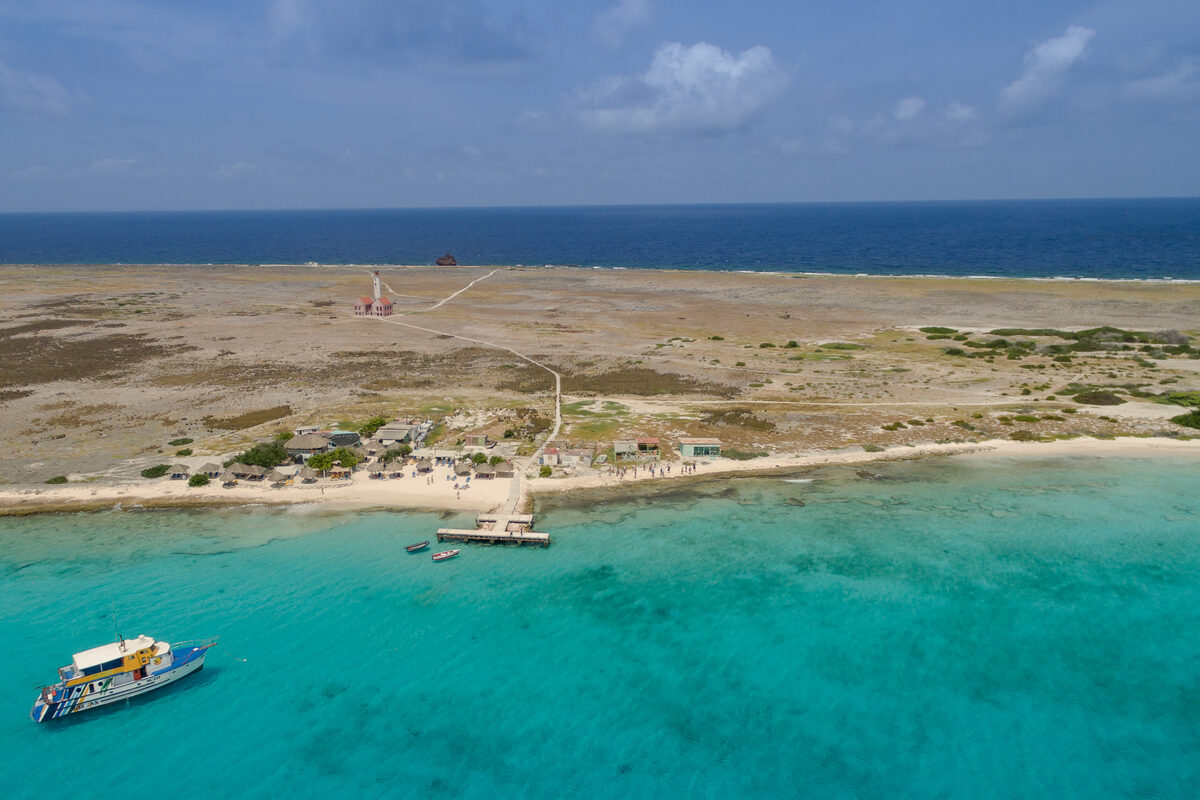
Klein Curaçao
A tiny uninhabited island reachable by boat in about 90 minutes. Miles of untouched white sand, no shade, no development — just ocean, silence, and one of the most pristine natural environments in the Caribbean. Bring your own everything.
Photos: Wikimedia Commons contributors — CC BY-SA 2.0
Why Visit Curaçao
The World Cup has put Curaçao on the map. Here is why it deserves to stay there.
Stunning Beaches
Curaçao's coastline is dotted with beaches that rival anything in the Caribbean. Cas Abao offers powdery white sand fringed by palm trees. Playa Kenepa (Grote Knip) is a dramatic cove with turquoise water framed by cliffs. And Klein Curaçao, a tiny uninhabited island a boat ride offshore, is the kind of place that makes you question why you ever go anywhere else.
Willemstad's Colorful Waterfront
The Handelskade — Willemstad's iconic row of pastel-colored Dutch colonial buildings reflected in the harbor — is one of the most photographed sights in the Caribbean and a UNESCO World Heritage Site. Cross the Queen Emma pontoon bridge to explore the neighborhoods of Punda and Otrobanda, where history meets street art, boutiques, and open-air restaurants.
Year-Round Warm Weather
Temperatures hover between 27–32°C (80–90°F) all year. Better yet, Curaçao sits outside the hurricane belt, making it one of the safest Caribbean destinations for travel at any time of year. The trade winds keep things comfortable even in the heat of summer.
World-Class Diving & Snorkeling
The waters around Curaçao are home to some of the best diving in the Caribbean. Coral reefs teeming with tropical fish sit just meters offshore. Many of the best snorkeling spots are accessible directly from the beach — no boat required.
Affordable Caribbean
Compared to Aruba, the US Virgin Islands, and other popular Caribbean destinations, Curaçao offers excellent value. Accommodation, dining, and activities are generally more affordable, making it accessible for a wider range of travelers.
Easy to Reach
Direct flights connect Curaçao to Amsterdam, Miami, New York, Toronto, and other major cities. Hato International Airport is modern and well-connected, making the island surprisingly accessible for a destination that feels wonderfully remote.
Plan Your Trip to Curaçao
World Cup or not, Curaçao is one of the Caribbean's best-kept secrets. Start planning your visit today.